

AI is changing how work is done faster than it is eliminating roles.
Real-world examples like Commonwealth Bank show companies redesigning work, not just cutting jobs.
The immediate impact is rising expectations and widening performance gaps inside teams.
The narrative is wrong
The dominant story is simple.
AI replaces jobs.
That makes for good headlines.
It’s not what’s actually happening.
Not yet.
What we said last year
Last year, I wrote that AI would change how we work before it changes who works.
That’s now playing out.
Roles are still there.
But the expectations inside those roles are shifting much faster than most teams realise.
If you haven’t read it, this was the argument in full:

The signal most people missed
When Commonwealth Bank announced its AI workforce strategy, the headlines focused on job cuts.
~300 roles removed.
That’s the visible part.
The more important move was the $90 million investment behind it.
A program to redesign how skills are built, how roles evolve, and how people move inside the organisation:
That is not a redundancy program.
It is a redesign of work.
I unpacked that shift in more detail here:

This is what AI adoption actually looks like
CBA is not alone.
Across industries, the pattern is consistent.
AI is not being deployed to remove entire roles.
It is being deployed to change how those roles operate.
At CBA:
Skills are being mapped dynamically
Careers are being redesigned around capabilities, not job titles
Work is being restructured to fit AI, not the other way around
This is the shift most companies are underestimating.
The bar moves
When AI increases output, expectations follow.
Quietly.
A role doesn’t disappear.
But what “good” looks like inside it changes.
Faster turnaround
Higher output
Better decisions
This is already visible inside teams.
And it compounds.
The tension leaders are starting to feel
This is not just theoretical.
You can hear it directly from leadership.
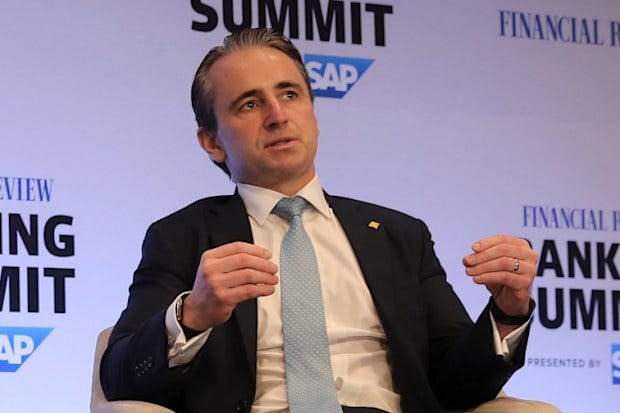
Commonwealth Bank CEO Matt Comyn put it clearly last week:
“This technology needs to lead to productivity and improvements in living standards, not valuations.”
That distinction matters.
Because right now, the market is rewarding the expectation of AI.
Not the realised output.
Most organisations are still being measured on the first.
While trying to build the second.
And inside organisations, that creates tension.
Performance expectations are rising.
But the systems, skills, and structures to support them are still catching up.
That gap is where most teams are operating today.
This is where the real impact sits
AI is not compressing headcount evenly.
It is widening performance.
The gap between:
People who can work with AI
People who cannot
Is increasing.
And it is becoming visible.
Most leadership teams are still asking the wrong question.
“How many jobs will AI remove?”
The better question is:
“What level of performance will we now expect from every role?”
Because this is where the real organisational change happens.
Below are the structural shifts already playing out inside teams, and the decisions leaders need to make now to stay ahead of them.
The three shifts inside organisations
These are already happening.
Not in theory.
In live systems.
1. The Compression of the Middle
AI removes coordination work.
Status updates
Basic analysis
Information relay
This is where many middle-layer roles sit.
As that work disappears, structures flatten.
Fewer layers.
Higher expectations per role.
2. The Rise of the Operator
The highest performers are pulling ahead.
They:
Use AI fluently
Move faster
Produce better output
AI removes friction.
Which makes performance differences obvious.
This is not a technology shift.
It is a talent shift.
3. The Exposure of Weak Roles
Some roles were sustained by process.
Or volume.
Or coordination.
AI removes that scaffolding.
And exposes whether the role actually creates value.
This is where reductions happen.
Not because AI replaces the role directly.
But because it removes the need for it.
The leadership mistake
Many organisations are reacting too early.
Cutting headcount.
Freezing hiring.
Trying to “get ahead” of AI.
But this misses the point.
Because the value is not in reducing people.
It is in increasing output.
What CBA got right
The signal inside the CBA move is simple.
Cut some roles.
Yes.
But more importantly:
Redesign the system those roles sit inside.
Because the long-term advantage is not fewer people.
It is better performance per person.
The operating shift
The question is no longer:
“How do we do the same work with fewer people?”
It is:
“How do we redesign work now that the work itself has changed?”
That means:
Reskilling
Role redesign
Clear performance expectations
The strategic opportunity
If AI increases output per person,
You have two choices.
Reduce headcount.
Or increase ambition.
Most companies default to the first.
The better ones choose the second.
The CEO question
If AI is already increasing output inside your teams,
Have you reset expectations to match it?
Or are you still managing to last year’s baseline?
Final point
AI is not a headcount story.
It is a performance story.
And increasingly, it is a structural story.
Because once work changes,
The organisation has to follow.