

The biggest AI job impact isn’t layoffs, it’s backfills quietly dying and junior roles quietly disappearing.
If your role is “move information around,” you’re on the clock.
AI won’t replace your whole team, but it will brutally expose who actually carries outcomes.
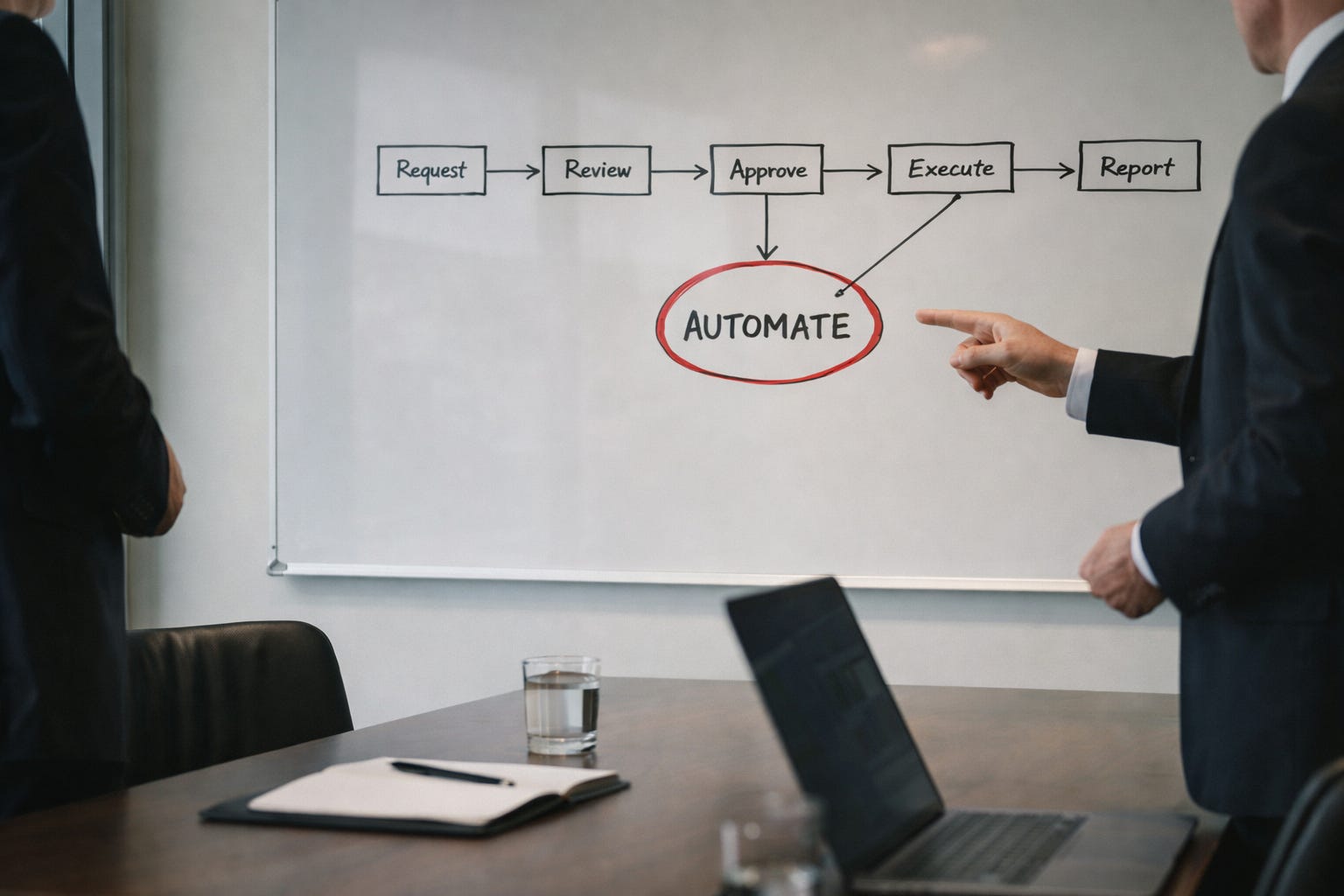
CEO Briefing: no hype, just the reality.
Let’s cut through it.
AI isn’t coming for “jobs” in the abstract.
AI is coming for waste: slow workflows, bloated handoffs, endless coordination, and work that exists mostly to keep the org chart busy.
So if you’re asking “who keeps their job?”, you’re already a half step behind.
The real question in 2026 is:
Who still creates value when the busywork disappears?
Because AI doesn’t kill organisations.
Leaders do, when they use AI as permission to cut instead of redesign.
The stat that matters, read it twice
In 2025, AI was cited in 54,836 job cuts, but restructuring drove 133,611. This is not a robot story. It’s a management story. (Challenger, Gray & Christmas, 2026a). (Challenger Gray)
AI doesn’t destroy jobs evenly. It destroys excuses.
And it forces leaders to decide what work they’ll keep paying for.
Here’s what the data says, the short version
This isn’t vibes. The shift is measurable.
Global: “AI layoffs” exist, but the bigger story is redesign
Challenger, Gray & Christmas tracked 54,836 job cuts in 2025 where AI was cited as the reason, and 71,825 since 2023 (Challenger, Gray & Christmas, 2026a). (Challenger Gray)
But AI remains a minority share of the “reasons” list compared to restructuring and market pressure (Challenger, Gray & Christmas, 2026b). (Challenger Gray)
Translation: AI is becoming the excuse. The real cause is leadership deciding what work matters.
Global: most jobs don’t vanish, they get repriced
Indeed estimates 26% of posted jobs are highly exposed to generative AI transformation, and 54% moderately exposed (Indeed Hiring Lab, 2025). (Indeed Hiring Lab)
Translation: most roles will still exist. They’ll just require more output, better judgment, and less tolerance for mediocrity.
Australia: hiring conditions make “silent cuts” easier
In Australia, the setup is perfect for quiet compression.
ABS job vacancies were 326,700 in November 2025, down 5.2% year-on-year. Private sector vacancies fell 6.8%, while public sector vacancies rose 8.9% (Australian Bureau of Statistics, 2026). (News.com.au)
Translation: companies don’t need layoffs to shrink headcount. They just stop replacing people.
Australia: the official view is still augmentation > replacement
Jobs and Skills Australia says GenAI is more likely to augment jobs than replace them, with uneven impact by occupation and industry (Jobs and Skills Australia, 2025). (Jobs and Skills Australia)
Translation: your job isn’t “gone.” But your old way of doing it is.
Australia: the RBA confirms the real constraint is execution
The RBA’s liaison with companies shows businesses expect AI to be labour-saving over time, but productivity uplift isn’t automatic, and barriers include regulation and skills access (Fernando, 2025). (Reserve Bank of Australia)
Translation: anyone can buy tools. Not many can run the change program.
What changed in the last 6 months; this is the actual shift
Here’s what happened while everyone was arguing on LinkedIn.
1) AI stopped being a toy and started being plumbing
Six months ago, AI was “draft my email” and “summarise this doc.”
Now it’s being embedded into:
customer support workflows
finance ops and approvals
internal reporting
campaign production
sales enablement
knowledge retrieval across the business
That’s when it becomes real.
Because tools don’t kill jobs.
Systems kill jobs.
2) The real job impact looks boring: it’s non-hiring
This is how headcount shrinks in the real world:
the coordinator leaves → nobody backfills
the junior marketer resigns → “let’s pause hiring”
the analyst role opens → “we’ll cover it with tooling”
the admin function thins → “we’ll centralise support”
That’s not a layoff story.
That’s a balance sheet story.
3) AI’s dirty secret: it creates a quality problem
The early pitch was speed.
Now leaders are learning what speed costs when you move fast with low trust:
wrong answers
legal exposure
customer blow-ups
reputational damage
“AI said so” accountability gaps
This is why 2026 isn’t “roll out AI.”
It’s govern AI or get burned by it.
Who keeps their job? Here’s the real map.
Forget titles. Titles lie.
The question is: what does the role produce?
If the role produces outcomes, it survives.
If the role produces updates, it compresses.
Simple.
The first roles to compress (not disappear, compress)
These roles get thinner fast:
1) Internal coordination work
Scheduling, chasing inputs, packaging status.
2) Reporting work that doesn’t drive decisions
Dashboards, weekly wrap-ups, summaries that nobody acts on.
3) Junior throughput roles
First drafts, variations, basic production, “busy hands” work.
4) Routine finance operations
Transaction processing and repeatable approvals.
The common thread is brutal:
low accountability + repeatable output.
The roles that don’t die, they just get harder
This is where most professionals live.
ops roles become ownership roles
PM roles become delivery roles
marketing roles become speed + quality roles
managers become enablement + accountability roles
If you’re average, AI makes you visible.
If you’re great, AI makes you lethal.
The roles that stay expensive (and get more valuable)
complex selling and relationship-driven revenue
high-stakes judgment and accountability
AI-build and AI-run capability
These don’t get replaced. They get hunted.
The CEO checklist, do this now, not “sometime”
Here’s the difference between winners and losers in 2026:
Winners redesign work. Losers cut people.
1) Stop paying for “magic”
If a tool can’t show a measurable outcome, cut it.
Not “we saved time.”
Real outcomes:
cycle time down
cost-to-serve down
error rates down
throughput up without quality collapse
2) Make AI visible inside the business
If you can’t see it, you can’t govern it.
Approved tools. Clear policies. Real training. Minimal nonsense.
3) Redesign roles before you punish performance variance
If AI is part of the job now, stop pretending it’s optional.
Rewrite:
role expectations
scorecards
what “good” looks like
4) Don’t accidentally kill your talent pipeline
If you cut juniors because AI can do “junior work,” you’ll build a leadership cliff.
Hire fewer. Train better. Build a pathway.
5) Make managers accountable for outcomes, not updates
Management isn’t “status reporting.”
Management is:
removing blockers
building capability
setting standards
owning delivery
6) Centralise governance, decentralise execution
Centralise: risk, legal, data rules, vendor standards.
Decentralise: workflow redesign in the teams doing the work.
7) Automate two workflows per function, end-to-end
Not twenty experiments.
Two workflows. Properly. Measurable impact.
8) Use AI to grow, not just cut
If your only move is cost-out, you’ll get leaner and dumber.
The real win is:
faster shipping
better service
higher output without higher coordination
Final word
AI won’t fire you.
But it will expose whether your organisation is built for outcomes or built for internal motion.
In 2026, CEOs don’t need AI magic.
They need a business that can move faster, deliver cleaner, and stay in control while doing it.
Because the companies that win won’t be the ones with the best tools.
They’ll be the ones with the best operating model.
References
Australian Bureau of Statistics. (2026). Job vacancies, Australia (November 2025). Australian Government. https://www.abs.gov.au/ (News.com.au)
Challenger, Gray & Christmas, Inc. (2026a, January 8). Challenger report: December 2025 job cuts [PDF]. https://www.challengergray.com/ (Challenger Gray)
Challenger, Gray & Christmas, Inc. (2026b, January 8). 2025 year-end Challenger report: Highest Q4 layoffs since 2008, lowest YTD hiring since 2010. https://www.challengergray.com/ (Challenger Gray)
Fernando, J. (2025, November). Technology investment and AI: What are firms telling us? Reserve Bank of Australia Bulletin. https://www.rba.gov.au/ (Reserve Bank of Australia)
Indeed Hiring Lab. (2025, September 23). AI at work report 2025: How GenAI is rewiring the DNA of jobs. https://www.hiringlab.org/ (Indeed Hiring Lab)
Jobs and Skills Australia. (2025, August 14). Our Gen AI transition: Implications for work and skills (Generative AI Capacity Study). Australian Government. https://www.jobsandskills.gov.au/ (Jobs and Skills Australia)