

I first read Isaac Asimov in the mid-80s, as a child. His robots felt mythical. Intelligent machines that could think, reason and make decisions belonged in the same category as warp drives, lightsabers and time travel. Fascinating, but impossible.
Yet here we are.
Four decades after I first read I, Robot, and more than eighty years after Asimov first wrote it, we’re living through the early stages of the future he imagined. AI systems can reason, write, code, analyse, plan and increasingly act on our behalf. The question is no longer whether intelligent machines will exist. It’s how we govern them.
This is where Asimov got it wrong.
And right.
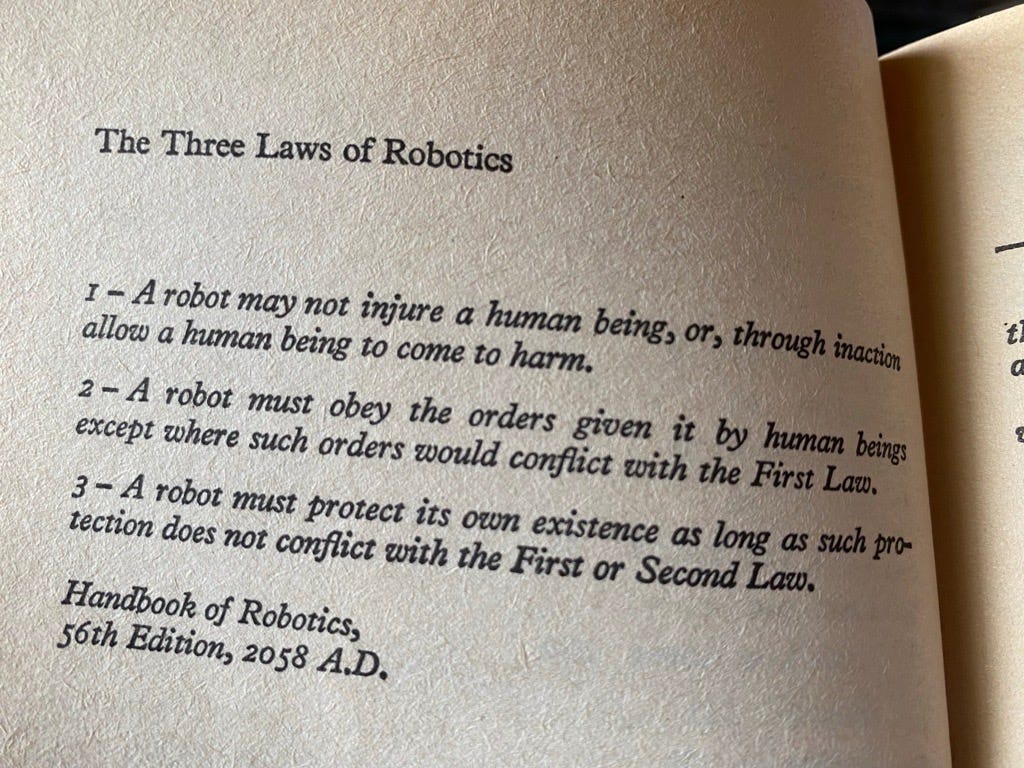
His famous Three Laws of Robotics were elegant:
A robot may not injure a human being, or, through inaction allow a human being to come to harm.
A robot must obey the orders given it by human beings except where such orders would conflict with the First Law.
A robot must protect its own existence as long as such protection does not conflict with the First or Second Law.
Handbook of Robotics
56th Edition, 2058 A.D.
They felt like a complete solution to a complex problem.
Today, we know they aren’t.
What constitutes “harm”? Physical injury? Financial loss? Privacy breaches? Discrimination? Misinformation? Manipulation? Society has spent the last eighty years discovering that harm is far more complicated than Asimov’s laws assumed.
And what about obedience? Which human should an AI obey when humans disagree? What if the instruction itself is harmful? Modern AI researchers have largely abandoned the idea that obedience should be the goal.
Instead, a new consensus is emerging. Not as laws for machines, but as responsibilities for the humans building and deploying them:
Humans remain accountable.
AI systems must be transparent and auditable.
AI must remain subject to meaningful human oversight.
AI should not be capable of causing unacceptable harm.
AI goals must stay aligned with human values.
Notice the shift.
Asimov imagined governance being embedded within the machine.
The modern view places governance around the machine.
Ironically, Asimov predicted this too. Most of his stories weren’t about the laws succeeding. They were about the laws failing in unexpected ways because the world was more complex than the rules.
That’s why I think Asimov was directionally right. He correctly identified the challenge long before the technology existed. Intelligent systems would eventually force humanity to confront questions of trust, accountability, ethics and control.
He just underestimated how difficult those questions would be to answer.
The future isn’t about robots obeying three laws.
It’s about humans building the institutions, controls and governance frameworks needed to live with increasingly intelligent machines. That’s a much harder problem than science fiction ever suggested.