
Most Leaders Ask The Wrong Question
The most expensive executive mistake is demanding answers before understanding the problem.

Most executive teams believe they have a decision-making problem. What they actually have is a diagnosis problem.
A transformation program falls behind schedule and leadership asks for a more detailed plan. A growth initiative misses expectations and another strategy review is commissioned. An AI rollout generates mixed results and governance expands. A new market opportunity emerges and the executive team spends months refining forecasts before making a move. In each case, intelligent people are trying to reduce risk. In each case, they may be making the situation worse.
The instinct is understandable. Executives are rewarded for being right. Boards reward confidence, investors reward predictability and organisations reward leaders who appear to have answers. Over time, this creates a powerful bias toward certainty. When uncertainty increases, leadership teams naturally respond by seeking more information, more analysis and more validation. Sometimes that is exactly the right response. The problem is that many of the most important challenges facing organisations today do not become clearer through analysis alone.
This distinction sits at the heart of a surprisingly common executive mistake. Leaders often assume every challenge can be solved using the same decision-making process. Gather the facts. Analyse the options. Build the business case. Execute the plan. That sequence works extremely well in some situations. It performs remarkably poorly in others. The issue is not the quality of the leaders or the quality of the analysis. The issue is that different categories of problems require fundamentally different approaches.
The certainty trap
Most executives spend their careers solving problems where expertise and analysis create a measurable advantage. A CFO evaluating an acquisition can improve the quality of a decision through deeper financial analysis. A COO redesigning a supply chain can model scenarios and optimise trade-offs. A CIO selecting a technology platform can compare vendors, assess risks and make a rational recommendation. These are difficult decisions, but they share a common characteristic. The answer exists. The organisation may not know it yet, but the answer can be discovered through expertise, investigation and analysis.
Success in these environments creates a powerful habit. Leaders become accustomed to the idea that uncertainty is simply a temporary lack of information. If the business gathers enough data, speaks to enough experts and performs enough analysis, the right answer will eventually emerge. The habit is reinforced because it works so often. The challenge is that many of today’s most important executive questions do not behave this way.
Culture change does not behave this way. Product innovation does not behave this way. Building a new market category does not behave this way. Responding to disruptive technology does not behave this way. In these situations, the future is not waiting to be discovered. It is being created through the actions of customers, competitors, regulators and the organisation itself. The answer does not exist yet. It emerges over time.
This is where organisations become trapped. Faced with uncertainty, they reach for the tools that have worked in the past. More planning. More governance. More analysis. More certainty. The result is that leadership teams become increasingly sophisticated at discussing the future while becoming progressively slower at influencing it. They mistake activity for learning and preparation for progress.

The framework that explains the mistake
Dave Snowden developed the Cynefin Framework after observing that organisations repeatedly struggled not because they lacked intelligence, but because they misclassified the problems they faced. Leaders would apply a management approach that was successful in one environment and assume it would work equally well in another. The problem was not execution. The problem was diagnosis.
The framework itself is deceptively simple. Some challenges are clear. The answer is known, best practices exist and consistency creates value. Some challenges are complicated. The answer exists but requires expertise to discover. Some challenges are complex. The answer emerges through experimentation and learning. Some challenges are chaotic. The immediate priority is stabilisation before deeper understanding becomes possible.
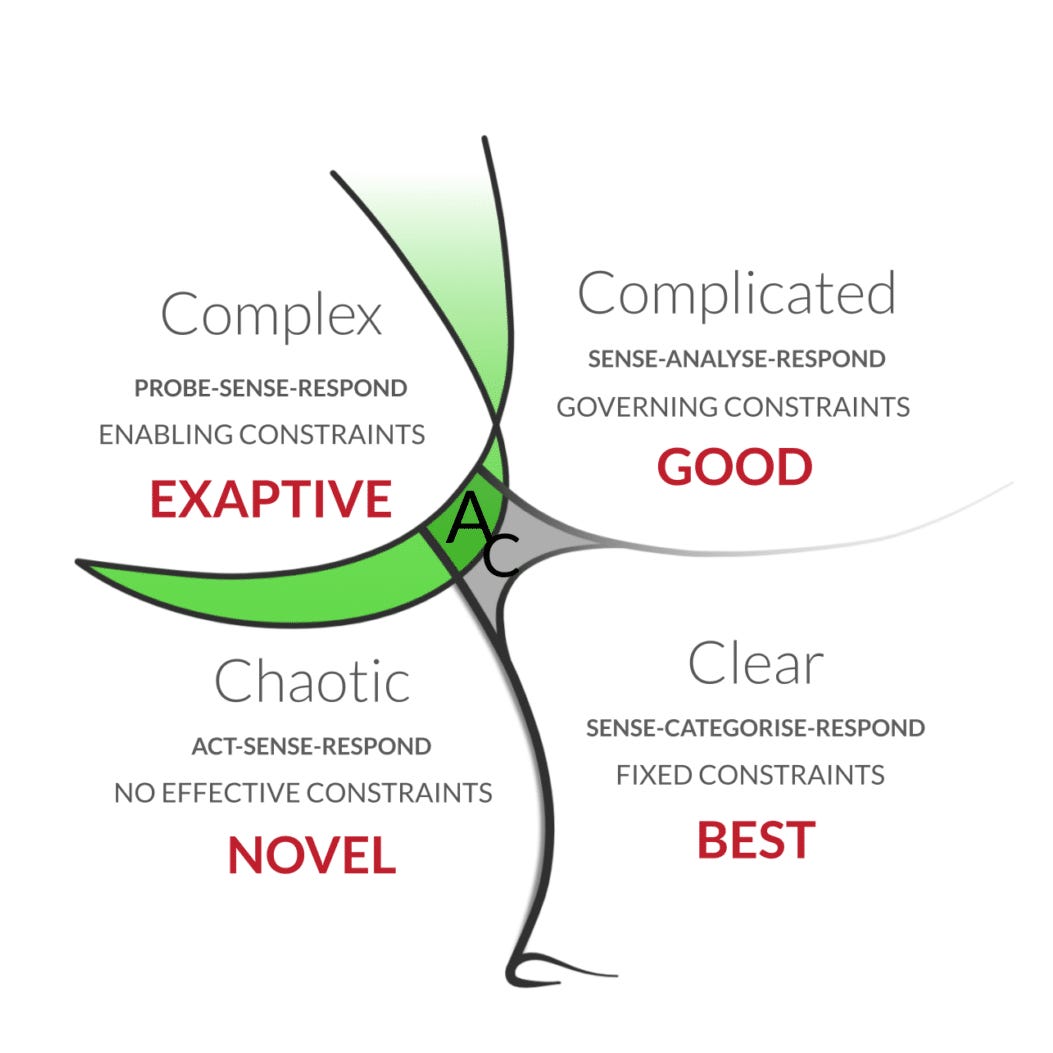
The power of the framework is not in the categories themselves. The power comes from recognising that different categories require different forms of leadership. A complicated problem benefits from analysis. A complex problem benefits from experimentation. A chaotic problem benefits from decisive action. The mistake most organisations make is treating all three as though they are merely complicated.
When that happens, transformation programs become trapped in governance structures designed for operational projects. Innovation initiatives become trapped in planning cycles designed for capital investments. Crises become trapped in committee discussions. The organisation applies the wrong operating system because it has misunderstood the nature of the challenge.
The executive test
Many strategy discussions begin with a familiar question: What should we do? The problem is that this question often arrives too early. Before discussing solutions, leadership teams should first ask what kind of problem they are solving. Is the answer already known? Can it be discovered through expertise? Must it emerge through experimentation? Or is the situation so unstable that immediate action matters more than analysis?
Very few organisations ask these questions explicitly. As a result, they spend months debating solutions to problems they have not correctly diagnosed. They argue about forecasts before understanding whether forecasting is even possible. They debate implementation plans before determining whether the answer needs to be discovered through experimentation. They optimise the wrong decision process because they never classified the challenge in the first place.
Use this prompt to pressure-test your assumptions before committing significant time, capital or attention.
Prompt: Problem Classification Audit
Act as a Strategic Advisor applying Dave Snowden’s Cynefin Framework.
We are facing the following challenge:
[Describe the challenge]
Determine whether the challenge is Clear, Complicated, Complex or Chaotic.
Explain the signals supporting the classification.
Identify where leadership may be misclassifying the problem.
Describe the management approach most appropriate for this category.
Explain what would happen if we applied the wrong management model.
Recommend the first action leadership should take.
Challenge assumptions rather than validating them.
The objective is not to solve the problem. The objective is to correctly diagnose the problem before solving it.
