

Something subtle is changing inside large organisations.
Executives are starting to ask their data questions directly.
And increasingly, the data answers back.
For decades, companies have run on reports.
Data flows into systems.
Analysts interpret it.
Managers review summaries.
Executives make decisions.
That structure has shaped how organisations operate for decades.
Generative AI is beginning to compress it.

Generative AI is compressing the analysis layer between operational data and leadership decisions.
Retail and industrial organisations are already deploying AI assistants to interpret operational signals.
Companies that adapt fastest will redesign how decisions are made inside the organisation.
Operational systems have always produced enormous volumes of data.
Sales transactions.
Inventory movements.
Production telemetry.
Logistics flows.
But interpreting that data required human synthesis.
Teams of analysts translated raw signals into reports, dashboards and forecasts.
Those reports then travelled up organisational hierarchies until they reached decision-makers.
The process was slow.
But it was necessary.
Most executives could not interact directly with operational data.
Generative AI changes that relationship.
Instead of waiting for reports, leaders increasingly query operational data directly through AI systems.
The shift is subtle but significant.
The analysis layer inside companies is collapsing.
Retail: Merchants Interacting With Data Directly
Large retailers are beginning to experiment with generative AI assistants for merchandising teams.
Walmart has deployed an internal generative AI tool known as “Wally”, which allows merchants to query operational data about product performance, sales trends and inventory conditions.
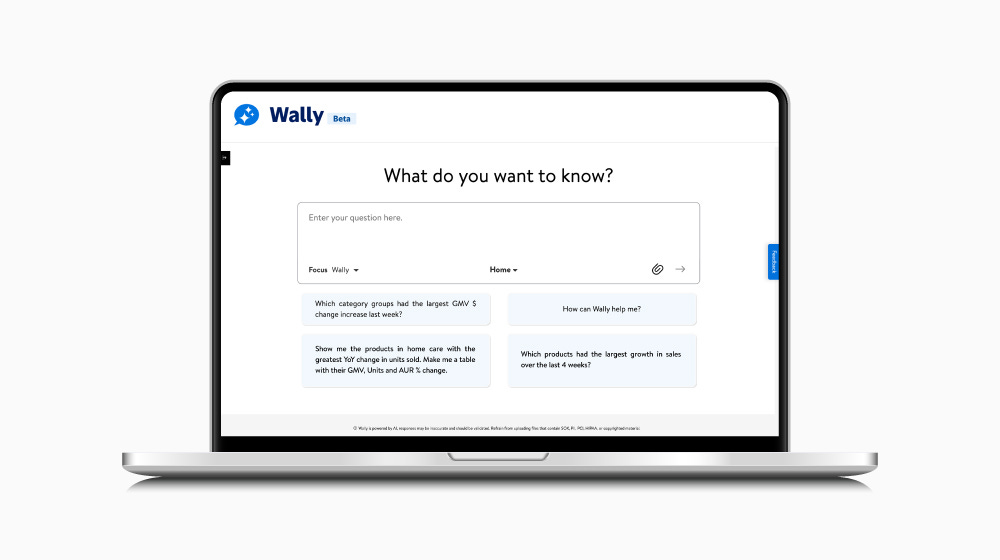
Instead of waiting for periodic reports, merchants can ask questions such as:
Why are sales declining in a particular region?
Which products are running low in specific stores?
Which suppliers are experiencing delays?
The system synthesises signals from across Walmart’s operational systems and produces summaries or recommendations.
The infrastructure underneath remains the same.
But the interface to it has changed.
Commerce Platforms: AI Interpreting Store Data
The same pattern is emerging among online retailers.
Shopify recently introduced Sidekick, a generative AI assistant designed for merchants running stores on its platform.
Merchants can ask operational questions such as:
Why did sales drop this week?
Which products should I reorder?
What inventory is moving fastest?
Instead of reviewing dashboards and reports, merchants interact with their business data conversationally.
Generative AI interprets the operational signals and returns explanations or recommendations.
In effect, the system becomes the interface through which merchants understand their business.
Manufacturing: AI Interpreting Factory Data
Industrial organisations are seeing the same development.
Siemens recently introduced its Industrial Copilot, a generative AI assistant designed to help engineers analyse production data and diagnose issues inside factories.
Manufacturing environments generate continuous telemetry from machines, sensors and production systems.
Historically, engineers interpreted this information through specialised software and manual investigation.
Generative AI allows engineers to ask questions directly about production anomalies or maintenance signals and receive explanations derived from operational data.
The engineering expertise remains essential.
But the analytical pathway has shortened.
The Layer That Is Disappearing
These deployments point to a broader structural change inside companies.
Historically, there were three distinct layers between data and decision.
Operational systems generated signals.
Analysts interpreted those signals.
Leaders made decisions based on the analysis.
Generative AI compresses the middle layer.
This is not simply a technology shift.
It is a management shift.
If generative AI is collapsing the analysis layer inside organisations, the real question is no longer data access.
It is decision architecture.
Below, I break down:
The three organisational layers generative AI is quietly compressing
The new decision model emerging in companies deploying AI at scale
The structural risk that appears when executives interact directly with operational intelligence
If you are responsible for running an organisation, not just experimenting with AI, these questions are worth answering early.
The Three Layers AI Is Compressing
1. The Analyst Layer
For decades, organisations relied on analysts to interpret operational data.
Sales analysts.
Supply chain analysts.
Financial analysts.
Their role was to translate raw signals into usable insight.
Generative AI increasingly performs parts of this translation.
Instead of waiting for reports, managers can query operational systems directly and receive summarised interpretations.
The analyst role does not disappear.
But its function changes.
Analysts shift from producing reports to validating AI-generated interpretations.
2. The Reporting Layer
Corporate decision-making has traditionally been organised around reporting cycles.
Daily reports.
Weekly dashboards.
Monthly performance reviews.
Generative AI weakens the need for these cycles.
Executives can interrogate operational data directly.
Questions that previously required new reports can now be answered instantly.
The report becomes less central.
Interaction becomes more direct.
3. The Planning Layer
Planning cycles have historically been built around forecasts.
Sales forecasts.
Demand forecasts.
Inventory forecasts.
Generative AI does not eliminate forecasting.
But it reduces the time required to interpret changing conditions.
Operational decisions move closer to the signal itself.
This changes the tempo of management.
Instead of reacting to reports, leaders increasingly interact with live operational intelligence.
The Risk Few Organisations Are Discussing
Compressing the analysis layer introduces a subtle organisational risk.
When executives interact directly with AI-generated interpretations of operational data, decision velocity increases.
But oversight structures may not evolve at the same pace.
Historically, analysts acted as filters.
They contextualised information and challenged assumptions before insights reached leadership.
When that layer compresses, organisations must ensure new safeguards exist.
Otherwise, faster insight can produce faster mistakes.
The Strategic Shift
Generative AI is often described as a productivity tool.
Drafting emails.
Summarising documents.
Generating code.
Those applications matter.
But the deeper transformation is happening inside operational decision-making.
Generative AI is becoming the interface through which leaders interact with their organisations.
The CEO Question
If your operational systems already generate the signals needed to run the business, the real question becomes simple.
Who inside the organisation can interpret those signals first?
Because the organisations that adapt fastest to generative AI will not simply analyse data more efficiently.
They will decide faster.
And in competitive markets, speed of interpretation often becomes speed of advantage.