

Employees may already be changing faster than the organisations they work for.
The real AI divide is forming through repeated habits, not access to tools.
Companies benefiting most from AI may simply be rebuilding behaviour faster.

The Workforce Is Changing Faster Than The Workplace
Some people now instinctively open ChatGPT before Google.
Others still use AI occasionally, mostly for experimentation, then return to their normal workflows.
That gap matters more than it appears.
One employee starts every draft with AI. Another still begins with a blank page. One asks AI to summarise reports, pressure-test ideas, structure meetings, and accelerate research. Another still treats AI as an occasional assistant layered onto an unchanged workflow.
At first glance, the difference feels small. Over time, it may become enormous.
Because the real AI divide may not ultimately be technical. It may simply separate people who rebuild their habits around AI from those who continue operating largely as they always have.
The data increasingly points in this direction.
Stanford’s 2025 AI Index found that 78% of organisations now report using AI in some form. Yet McKinsey found only 1% of executives describe their companies as “mature” in AI adoption, meaning AI is fully integrated into workflows and generating meaningful business outcomes.
That gap matters.
It suggests most organisations now have access to AI tools, but relatively few have deeply changed how work actually happens.
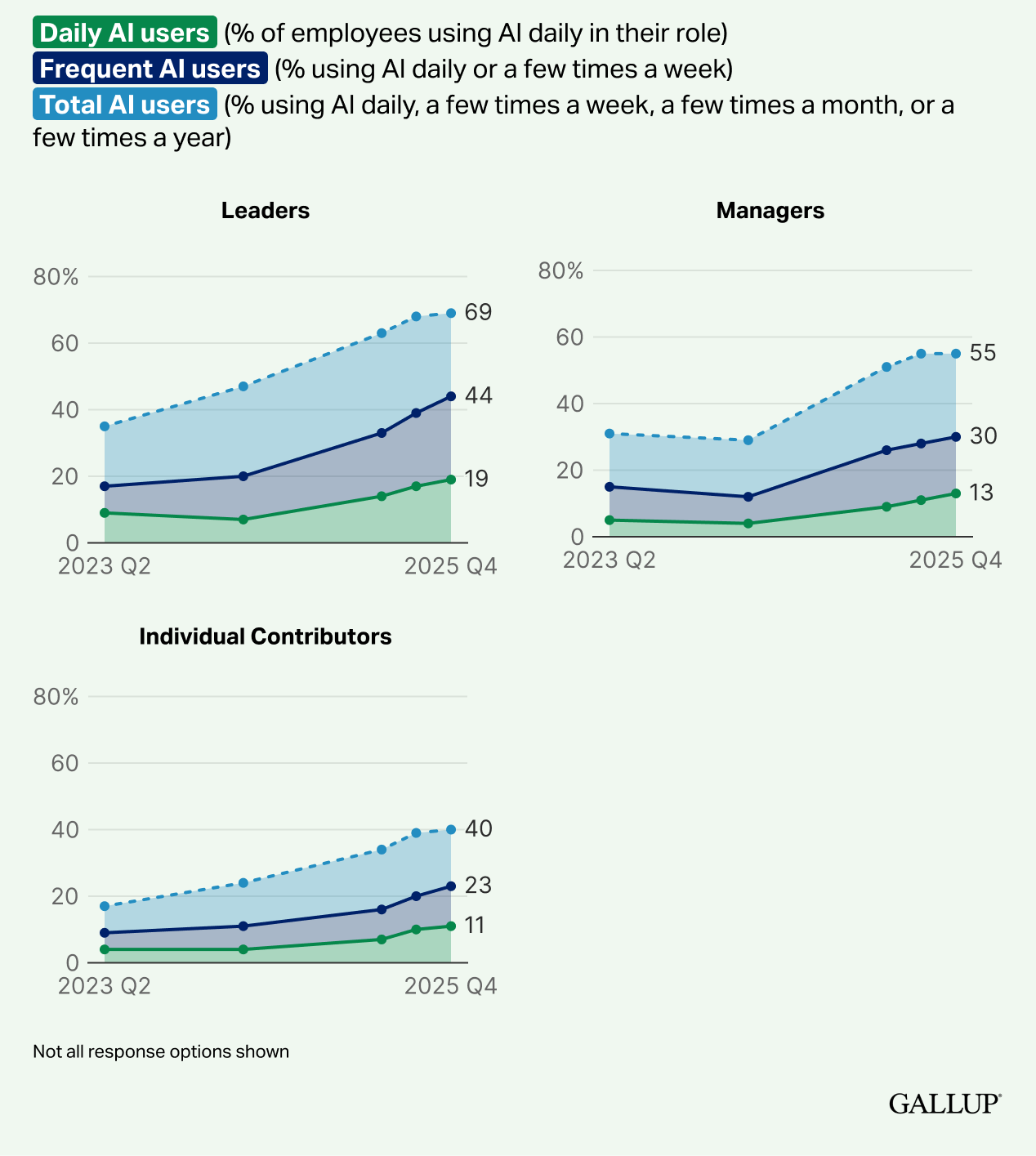
Gallup’s workplace research tells a similar story. Around 40% of employees report using AI at work at least occasionally, but only a small percentage use it daily. In remote-capable knowledge work, habitual use rises sharply, particularly among leaders and highly digital teams.
The implication is becoming difficult to ignore.
Access to AI is spreading rapidly. Behavioural integration is not.
The real AI divide may not be access to tools. It may be the speed at which people rebuild their habits around them.
Technology Changes Faster Than Habits
Organisations consistently underestimate how difficult habits are to change.
Corporate history is full of technologies that promised behavioural transformation but were mostly absorbed into existing routines.
Email did not eliminate meetings. In many organisations, it increased them.
Slack did not eliminate email. It simply created another communication layer.
Dashboards did not eliminate PowerPoint. Most companies still converted dashboards into presentations for executive meetings.
Technology changes quickly. Human routines rarely do.
Generative AI may follow the same pattern.
Many organisations currently describe themselves as “adopting AI” when what they are really doing is layering AI tools onto fundamentally unchanged workflows, management structures, approval systems, and communication habits.
The software changes immediately. Behaviour changes slowly.
The interesting part is not that AI tools are spreading quickly.
It is that repeated AI usage appears to be changing behaviour itself.
That shift may become one of the most important competitive dynamics of the next decade, particularly for organisations still treating AI as a software rollout rather than a behavioural transition.
The rest of this article explores where the real divide may emerge, why some companies are already pulling ahead, and what leaders may still be underestimating.
